
CMS's projected overall impact for Dermatology
CMS's own reconciliation table (Table D-B5) puts dermatology at -9.4% for 2027. That figure is the specialty-wide, volume-weighted change in total RVU-based allowed charges: the aggregate gain or loss across every code the specialty bills, before the separate conversion-factor cut. Fulcrum's reconstruction agrees closely at -9.9%, a net reduction of $356 million in national allowed charges.
Dermatology bills about 97% of its Medicare dollars in the office (non-facility) setting. By site of service, the 2027 change splits as follows:
| Site of service | Change | Allowed $ |
|---|---|---|
| Office (non-facility) | -10.1% | -$348M |
| Facility | -7.0% | -$8M |
All figures are national, hold 2025 utilization fixed, and exclude the separate 1.68% conversion-factor cut that lands on every specialty on top of this.
The core mechanical and discretionary factors driving the RVU shift
Several proposals drive the move in dermatology's RVUs. The table below spotlights the largest drivers of the net -$356M change; it is not a complete accounting of every code-level revaluation.
| Driver | Type | 2027 impact |
|---|---|---|
| Same-day billing reduction (modifier 25) | Discretionary | -$266M |
| Practice-expense overhaul (IPCI removal + PE stabilization cap) | Mechanical | -$89M |
Same-day billing reduction (modifier 25). It pays the most expensive service on a claim at 100% and every other same-day service at 50% whenever an office E/M is billed the same day as a 0-, 10-, or 90-day global procedure. It is a discretionary policy choice: CMS floated a 25% alternative.
Practice-expense overhaul (IPCI removal + PE stabilization cap). It removes the Indirect Practice Cost Index over two years (half the effect in 2027) and caps any code's PE change at plus or minus 5% in a given year. The result is a near-uniform, mechanical haircut on high-overhead office-based specialties, redistributed toward therapy and behavioral-health services.
How the rule affects different kinds of dermatology practices
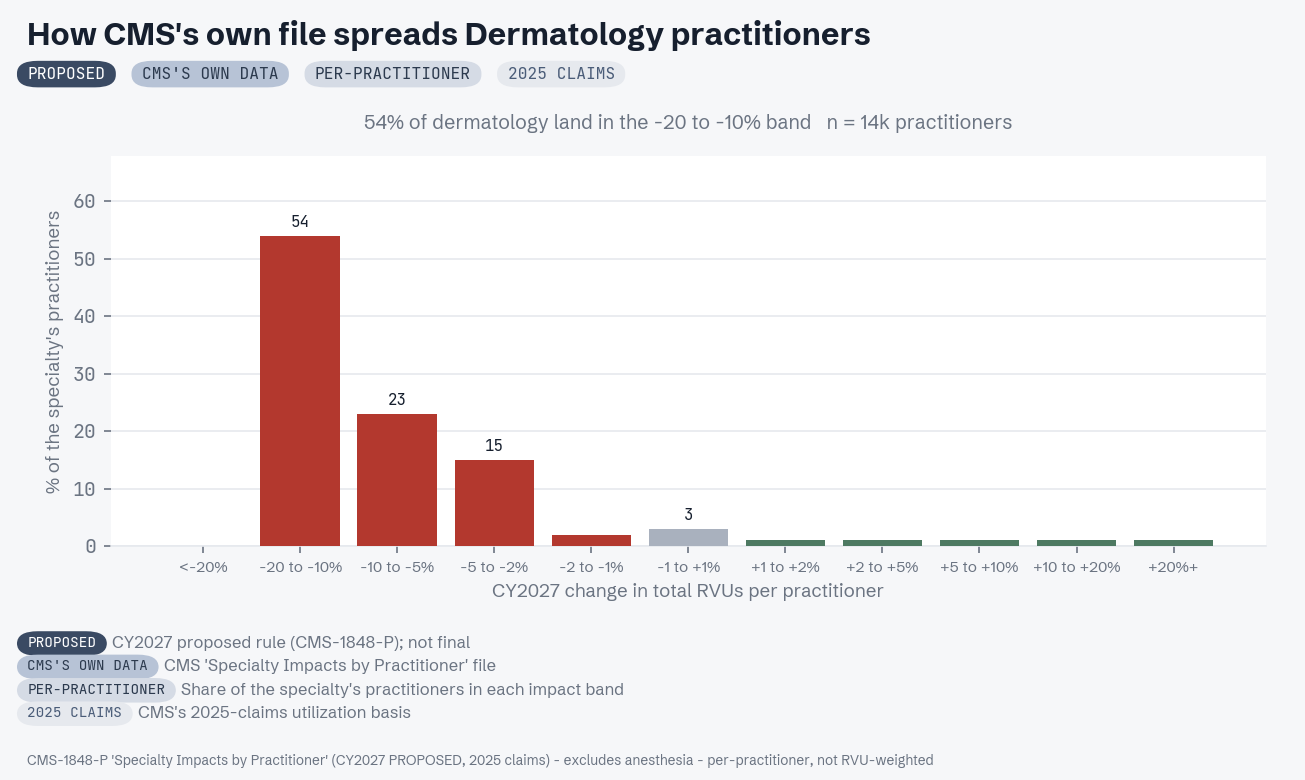
The specialty average hides a wide spread, demonstrated well by CMS's impact files. 54% of dermatology practitioners land in the -20 to -10% band, with 92% overall seeing a cut deeper than 2%. Where a practice lands is a question of service mix: the practices hit hardest are those with the heaviest same-day billing (an office visit alongside a destruction, biopsy, excision, or Mohs procedure).
How the rule affects specific service categories and CPT codes
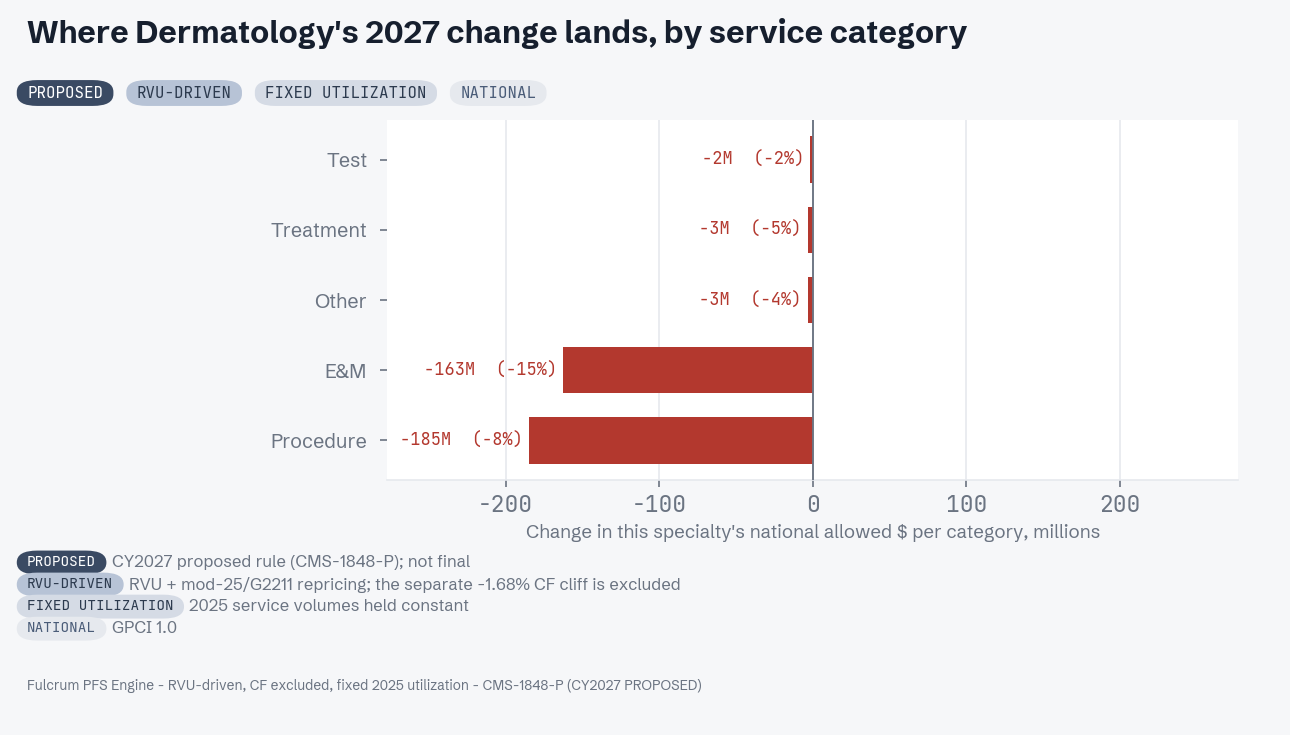
The chart below breaks down total RVU changes by service category, with procedures representing the greatest total drawdown and E&M performing the worst on a percentage basis:
Top 5 codes by dollars lost:
| HCPCS | Description | Setting | Change ($M) | Change (%) |
|---|---|---|---|---|
| 99213 | Office o/p est low 20 min | Office | -117.1 | -20% |
| 17000 | Destruct premalg lesion | Office | -66.9 | -33% |
| 11102 | Tangntl bx skin single les | Office | -27.9 | -15% |
| 17110 | Destruction b9 les up to 14 | Office | -27.4 | -14% |
| 99214 | Office o/p est mod 30 min | Office | -17.2 | -5% |
Top 5 codes by dollars gained:
| HCPCS | Description | Setting | Change ($M) | Change (%) |
|---|---|---|---|---|
| 96921 | Excimer lsr psriasis 250-500 | Office | +0.2 | +9% |
| 96922 | Excimer lsr psriasis>500sqcm | Office | +0.2 | +8% |
| 96920 | Excimer lsr psriasis<250sqcm | Office | +0.1 | +2% |
| 15275 | Skin sub graft face/nk/hf/g | Office | +0.1 | +3% |
| 99309 | Sbsq nf care moderate mdm 30 | Facility | +0.1 | +12% |
Code-level figures are priced on CMS's 2025 utilization crosswalk and include the proposed same-day (modifier 25) and add-on (G2211) billing policies, meaning a code can move more here than its Addendum B RVU change would indicate.
How Dermatology practices can quantify how the proposed rule affects them specifically
A national specialty estimate does not predict the result for an individual practice. Service mix, payer contracts, sites of service, and provider compensation structures determine how the proposed rule translates into real revenue impact.
Fulcrum models the proposed fee schedule against a practice's actual utilization and Medicare-linked commercial contracts to provide dynamic, accurate forecasts. To request an analysis, visit fulcrumhealth.co/pfs.html.
The one-time analysis requires no integration, only a secure file transfer after a BAA is in place. Within 72 hours, Fulcrum delivers a practice-specific dashboard showing the revenue effect by service, code, and payer product, along with the decisions that warrant attention before the new fee schedule takes effect.
Sources: CMS-1848-P proposed rule and supporting files and the CMS proposed-rule fact sheet. Figures reflect the proposed rule; comments close September 14, 2026. They are national (geographic indices set to 1.0), hold utilization fixed at CMS's 2025-claims basis, and are shown pre-sequester. Fulcrum figures are a proprietary reconstruction of the Medicare payment build-up, not proprietary claims data. Proposed values are not final and may change.