
Medicare PFS resources
Turn fee-schedule changes into practice decisions.
Clear analysis for finance teams that need to understand what changed, which services are exposed, and how Medicare updates flow through commercial contracts.
Start with the question
Three levels of PFS intelligence.
Annual rule changes
Understand the proposed policies, timing, and payment mechanics behind the CY 2027 update.
View the rule analysis →02Specialty impact
See where the national estimate comes from and which services and codes drive the result.
Read the dermatology analysis →03Practice-specific forecast
Apply the rule to your CPT utilization, locality, and Medicare-linked contracts in 72 hours.
Request an analysis →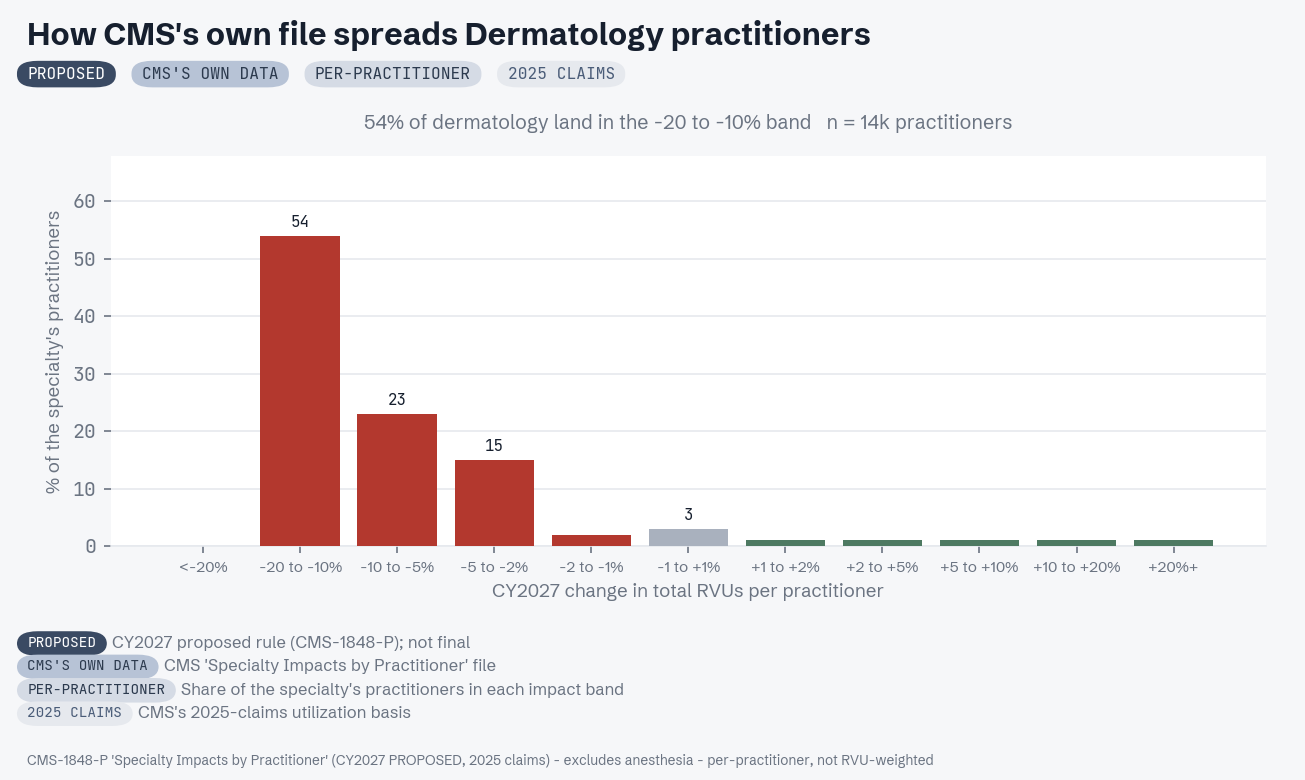
Latest research
CY 2027 PFS impact for dermatology.
CMS estimates a 9.4% decline in RVU-based allowed charges before the separate conversion-factor change. Fulcrum's reconstruction estimates 9.9%, with wide variation across practitioners and service mixes.
Read the analysis →How the work is built
Trace the estimate back to the source.
Fulcrum separates CMS's national specialty estimate from the forecast for an individual practice. See the inputs, assumptions, reconstruction steps, and limits behind the analysis.
Read the methodology →PFS questions
The terms finance teams need to use.
What is a Medicare PFS impact analysis?+
A PFS impact analysis applies Medicare fee-schedule changes to a practice's actual CPT utilization, locality, sites of service, and Medicare-linked contracts to estimate how reimbursement may change.
Why does a specialty average differ from a practice forecast?+
A specialty average combines many different service mixes. A practice forecast reflects the codes, volumes, payer products, and sites of service that are specific to one organization.
Can a Medicare PFS change affect commercial revenue?+
Yes. Commercial contracts that reference Medicare rates or fee-schedule logic can move when the Medicare PFS changes, depending on each contract's language and effective dates.